
Hearing an adult talking to an infant might sound gently musical!
Well, it indeed is a musical aspect. We use a higher pitch, slower speaking rate, simplified grammar and exaggerated facial expression while talking or playing with infants. These aspects apart from drawing an infant’s attention, also convey a positive effect (“happy talk”) and help infants in acquiring language. Babies primarily prefer this form of an Infant-directed Speech at least till toddler-hood. It has a positive effect on attentional, communicative and linguistic abilities of the child at a later stage.
The higher pitch helps the baby sustain his/her attention on what is being said and makes the words stand out more, leading to better vocabulary development. The vocabulary development is dependent on the quality and the quantity of the language input the child is receiving; the more the number of words a child hears, the greater the vocabulary development and with respect to the quality, the richness of vocabulary, repetitions of heard words, and a good grammar can facilitate vocabulary development in the child.
A child enjoys, not just a “happy talk”; “happy singing” too!
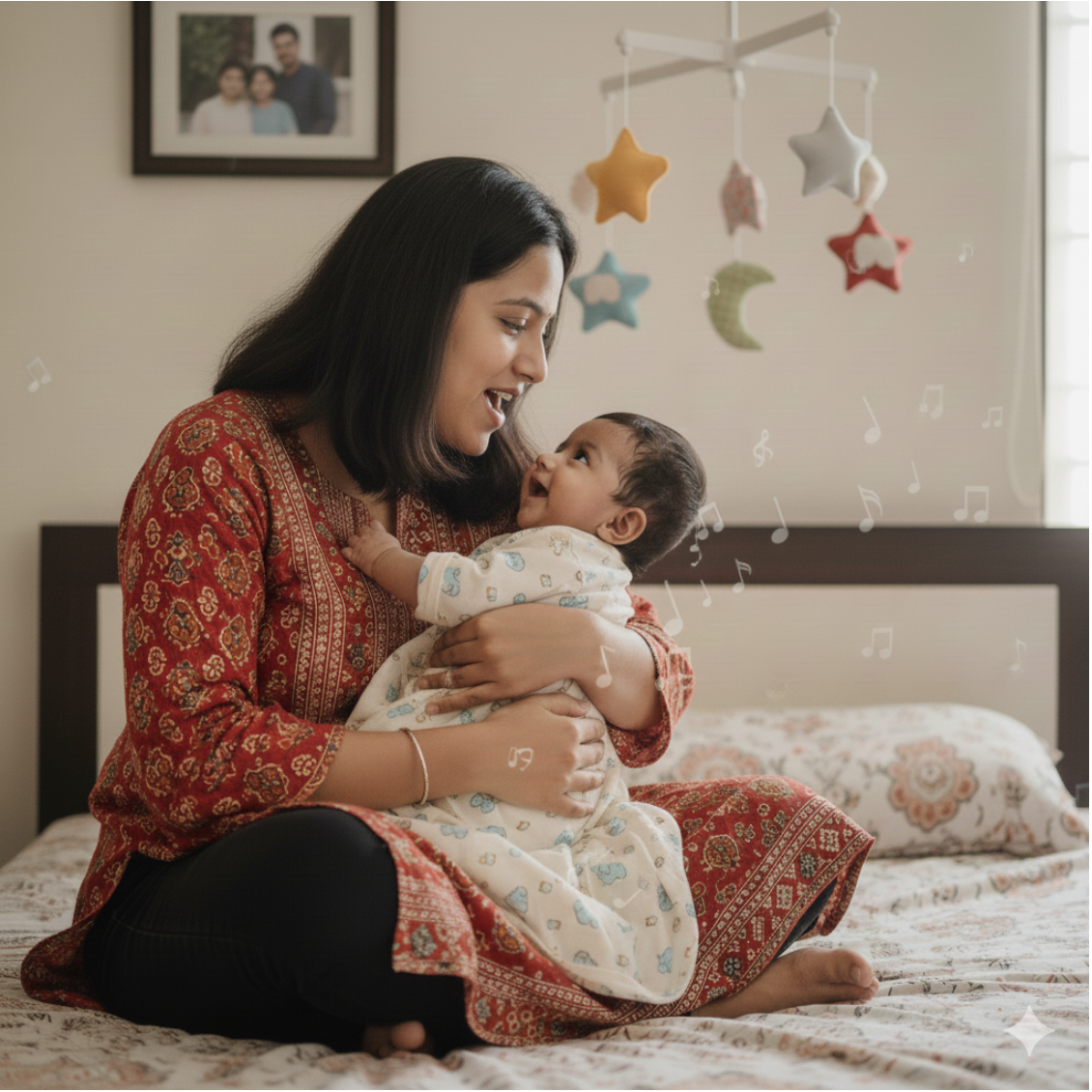
Infant-directed Singing is a culturally universal phenomenon and primarily used to modulate infant’s arousal. Similar to infant-directed speech, infant-directed singing is uniquely characterized by higher amplitude (loudness), more variations in pitch and a slowed tempo. These exaggerated acoustical cues are tied along with other cues such as greater physical movement (patting the infant), exaggerated facial expressions and more communicative gestures.
From an infant’s perspective, this is not just an auditory experience. It becomes multimodal involving the mother’s/caregiver’s constant smile, body contact and movement. This is an overall comforting experience providing pleasure and a sense of belonging for infants.
In many circumstances, the caregiver’s songs help babies stay calm and recover from distress sooner compared to talking. Babies listen longer to songs than to speech, especially a familiar song sung by a familiar caregiver quickly creates a sense of connection and when the baby feels safe, the distress reduces. This also carries social implications, i.e., when a familiar song is sung by a stranger, infants are comparatively more responsive.
Studies on musical stimuli show, a vocal stimulus elicits greater attention from an infant compared to an instrumental stimulus. This said preference to songs over speech starts to decline after 1 year of age as the child starts to pay attention to the most predominant form of communication in his/her environment which is spoken language. But, until the preference shifts, songs are one most powerful form of communication as it in essence, it holds the attention-grabbing prosodical aspect of music, the preferred voice and the environment adhering speech sounds.
In return, singing benefits the singers too. A playful song from the mother sparks interaction and fosters shared attention, whereas a calm lullaby reduces arousal in both the mother and the infant. Practicing infant-directed singing regularly is also said to lessen postnatal depression in mothers, improving their self-esteem. So, when you are singing to your child, you are just not merely singing, but strengthening your bond with your child, giving a memorable and appealing experience for your child and also as a welcome perk, paving a way for richer language development.
And if a little song can make you feel better too, why skip it?
Go ahead, every tune is an experience- for you and your little one!
Dikshitha Anand (Speech Language Pathologist)
Research Assistant,
AblePro Solutions Pvt. Ltd.